June 2024 → June 2026
From Executive Operator to AI-Native Strategist
Two years deep inside AI tools, automation, local models, and AI-assisted development. Not from the sidelines, by building, breaking, shipping, and comparing what works in real workflows.
2026 Velocity · Claude Code
Since June 2024
- 31 repos, 7,260 commits across two years.
- ~80% of 2026's code shipped from six products, led by MeritPlaybook at 323K lines.
- Heritage Whisper alone: 2,785 commits and counting.
Why this matters
Most AI advice comes from people who've either never operated a business or never built anything real with the tools.
I wanted both. I already knew sales, operations, enablement, incentives, customer experience, and executive strategy. The missing piece was understanding what AI could actually do when you push it hard.
This page is the receipts on that learning curve.
What I'm working on this month
- Building Heritage Whisper toward production launch.
- Running a local LLM stack for private workflow experiments.
- Testing OpenClaw for autonomous browsing tasks.
- Building a real-time conversational prompt refinement tool that role-plays, scores, and refines prompts before they ship.
Updated monthly.
How It Happened
Five phases. Two years. A lot of late nights.
The Curious Beginner
Understanding feasibility and breaking the "magic" barrier.
The "Big Bang"
Rapid experimentation. Learning by shipping. Breaking things.
Architecting Heritage Whisper
Production-grade architecture, security, and strategic constraint.
The AI-Native Operator
Scale, SEO, advanced automation, and "AI Leader" operations.
The Multiplied Operator
One operator, output like a team: multi-agent orchestration, a production AI cluster, and teaching what actually works.
Built With


















The Tuition
What it actually took to become AI-native.
No bootcamp, no CS degree, no playbook. 17 months of testing every frontier tool, burning through tokens, and building a local cluster to run it all.
Top Spend · 17 Months
Five tools over $2,000 each.
Where 17 months of frontier testing actually went.
Breadth
Ten categories. One operator.
Most "AI users" live in one app. Real fluency means knowing when to reach for which tool, and which to leave behind.
Frontier LLMs
5Claude · ChatGPT · Gemini · Grok · Perplexity
Local LLM
6Qwen 3.5 397B · Qwen 3.6 35B · DeepSeek R1 · LM Studio · Ollama · Qwen 2.5
AI Coding
9Claude Code · Cursor · Replit Agent · v0 · Factory AI · Copilot · Codex · Aider · Cline
Image Gen
7Midjourney · DALL-E · Gemini · Flux · Stable Diffusion · Nano Banana · Promptchan
Video Gen
6KlingAI · Runway · Sora · HeyGen · Beautiful.ai · Gamma
Voice / Audio
8Wispr Flow · ElevenLabs · Auphonic · Suno · Whisper · AssemblyAI · Otter · Voicemod
Agent / Orchestration
4OpenClaw · LiteLLM · Open WebUI · AnythingLLM
MCP / Search
6Ref.Tools · Exa · SearXNG · Serper · Context7 · Brave
Build / Design
9Google AI Studio · NotebookLM · Whimsical · Excalidraw+ · Mobbin · Canva · Aura · Lovable · Pompeli
Infrastructure
12Vercel · Supabase · GitHub · Cloudflare · SendGrid · Adobe · Make.com · Resend · Notion · DocuSign · Wix · Firebase
Discernment
I keep what works. I drop what doesn't.
A 50/50 split between active and dropped tools isn't churn. It's how you learn what actually earns its place in a workflow.
Kept · Active Daily
35- ClaudePrimary thinking partner
- ChatGPTPro + API
- GeminiWorkspace + mobile
- OpenClawCluster orchestrator
- ElevenLabsVoice synthesis
Tried · Dropped
35- Otter.ai→ Whisper API
- GammaQuick trial, didn't stick
- HeyGenAvatar quality
- Replit AgentHeavy use, then graduated
- DeepSeek R1 671BBenchmarked, moved on
Volume isn't taste. The dropped column is where the taste lives.
The AI Rig
Four machines. One cluster.
$15K+ in hardware. Networked, orchestrated, running 24/7. Most AI users rent. This stack runs at home.
Orchestrator
Mac Mini
Apple Silicon · Tailscale
Runs OpenClaw. Dispatches jobs across the cluster.
Frontier LLM
Mac Studio
M3 Ultra · 512GB RAM
Runs Qwen 3.5 397B locally via LM Studio.
Worker Node
Mac Studio
M4 Max · 64GB RAM
Second OpenClaw worker. Parallel agent execution.
Image / Video
4090 PC
RTX 4090 · 24GB VRAM
Runs Stable Diffusion + a second local LLM.
Learning From the Best
The content creators who shaped my AI & vibe coding journey
Evolution of Thinking
The long prompt is way worse than the short prompt.
After testing Pearl AI. Complexity was hurting performance.
Pearl can not have any opinions. Is that clear in here?
Defining the AI as a "witness," not a therapist.
Let's stop the incremental patches. The system is fundamentally broken.
Recognizing architectural debt. The shift from "Help me make X" to systematic engineering.
If it runs 24/7, treat it like production infrastructure.
Feb 2026, while hardening OpenClaw automation.
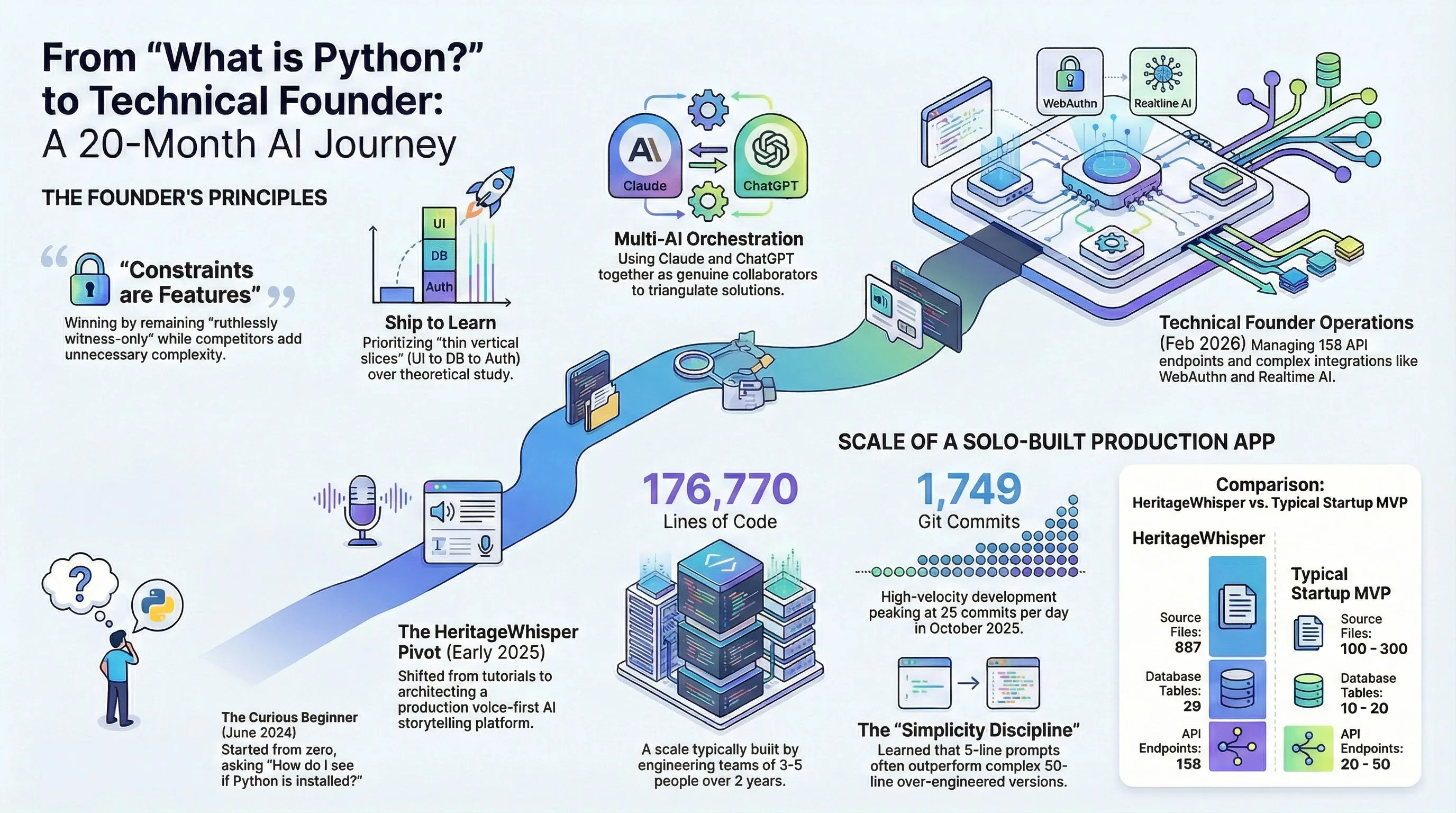
The Journey Visualized
What I'm Building Now
Three operator-built products in active development.
Voice-first platform helping families preserve stories across generations.
Personalized, research-backed scholarship strategy plans and recommendations.
AI visibility platform helping mortgage loan officers see and fix what weakens trust.
If you have questions about this journey, want to share your own experience, or just want to connect, I'd love to hear from you.
Connect on LinkedInThe thinking behind the build: